AI agents in marketing: 5 tasks you can already delegate today
AI agents in marketing: 5 tasks you can already delegate today, what each one requires and what not to delegate yet.
Published on
6 min read

AI agents in marketing deliver well when they get a clear question about data that is already organized. Outside that condition, they write a convincing text about an operation they do not know. The five tasks below fall within that condition, and you can test all of them this week.
Before the list, the prerequisite that runs through all of them. An agent connected to your database needs to know what each thing means in your company: what the stages of your funnel are, what your events are called, which custom fields exist, and what your house UTM convention is. Without that, it guesses the structure and the answer comes out wrong while looking right. At Laiki, that context is the account's Data Knowledge Base, and it is what turns a query into a reliable answer.
The connection happens through an open protocol, MCP, which standardizes the agent's access to data. If the subject is new to you, we explain what MCP is in detail.
1. On-demand one-off report
The question that comes up once and disappears. How many paid media leads became opportunities last quarter, broken down by campaign. What was the cost per lead of the July campaign compared to June's.
This is the best use of the agent, because building the report takes more work than the answer is worth. You ask in plain language, it queries the database and returns the number with the breakdown you asked for.
What the agent needs: the data to be centralized and the funnel stages to be named. What stays with you: deciding whether the number makes sense and what to do with it.
2. Campaign performance summary
Instead of opening three managers and building the comparison by hand, you ask for the summary of the period: what you invested, what came in, what changed compared to the previous period, and where the biggest variation is.
The gain here is preparation time. The agent does the collection and organization, and you arrive at the meeting with the analysis ready to discuss.
A precaution worth taking: always ask it to show the numbers that support the conclusion. A summary without numbers underneath is an opinion, and you already have plenty of opinions in the meeting.
3. Reading the profile of a specific lead
Before a sales meeting, the salesperson asks what that contact has done so far. The agent returns the timeline: where they came from, which pages they visited, which emails they opened, what stage they are in, and for how long.
It is a small task that changes the conversation. The salesperson walks in knowing whether the person went through the pricing page three times or downloaded a resource and vanished.
What the agent needs: active behavior tracking and the same contact resolved as a single person, rather than scattered across three records.
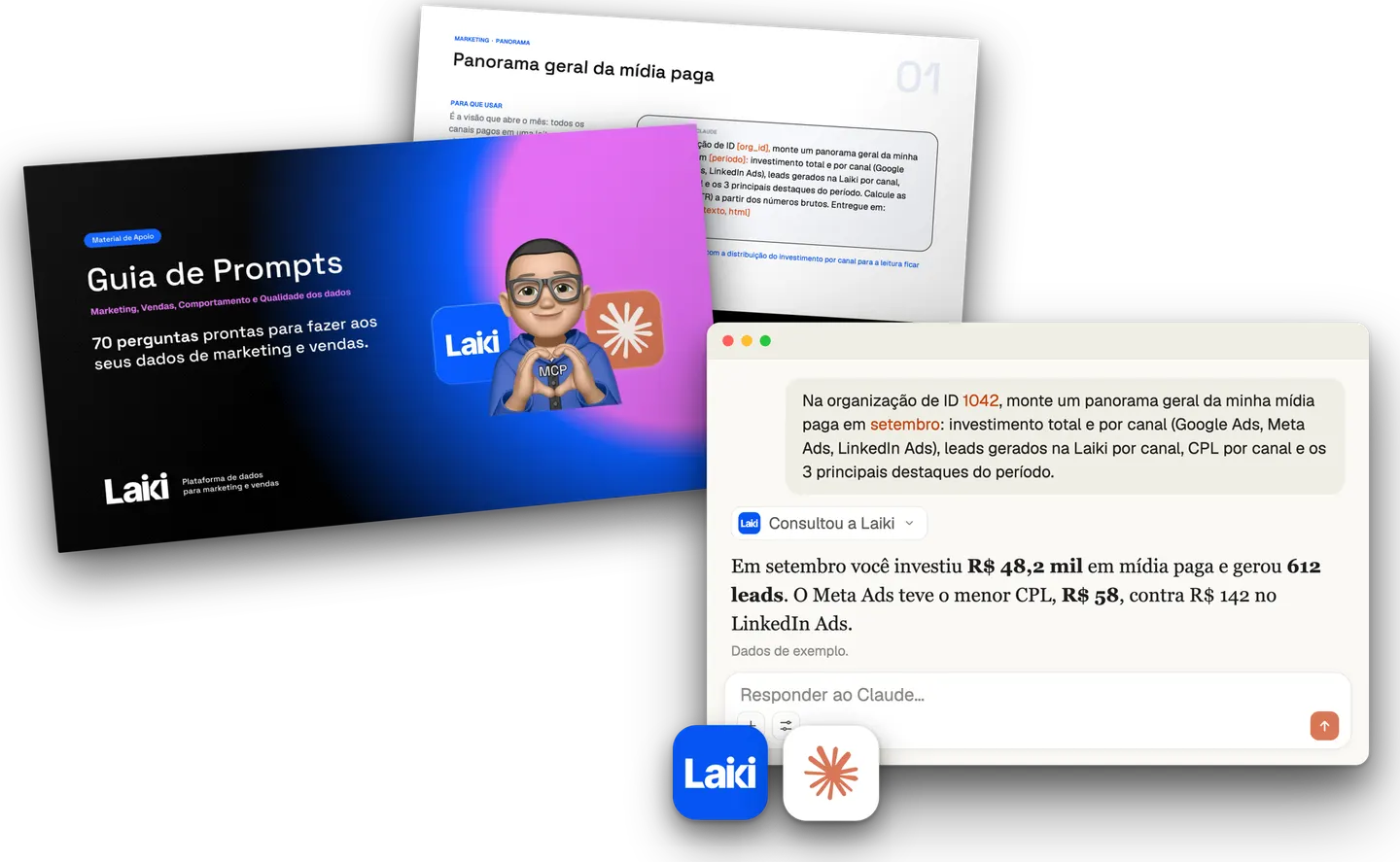 Resource · In PortuguesePrompt Guide for Marketing and Sales70 prompts with questions about marketing, sales and behavior to ask your data.Download the guide
4. Analyzing the behavior of a group of leads
Here the scope stops being individual. You ask what an entire segment did in recent days: the leads that came in through the September campaign, or the ones stuck at the proposal stage for more than two weeks.
The agent describes the group's pattern, and the reading is usually more useful than the overall average. An example: among the leads who visited the pricing page last week, most arrived through search and have not yet been contacted by sales. It is a sentence that turns into action the same day.
The honest limit: the agent finds the pattern, you decide the cause. Correlation is not causation, and that part remains human work.
5. Weekly action plan for the sales team
The most complete task on the list, and the one that saves the most time. Every Monday, you ask for the list of who the team should contact first, with the reason for each name.
The criterion combines two things: recent engagement, such as visits and opens, and fit with the ideal customer profile. The result is an ordered queue, with a line explaining why that lead is at the top.
What the agent needs: your ICP criteria written somewhere it can read, and the behavior recorded. What stays with you: reviewing the queue before sending it to the team. The agent suggests the order, and the manager confirms the priority.
What not to delegate yet
It is worth being specific about the other side, because that is where most tests with AI agents in marketing end in frustration.
Do not delegate budget decisions. The agent can show that a channel has a higher cost per sale, but reallocating budget involves context that is not in the database: supplier contracts, seasonality, a promise made to the leadership.
Do not delegate conclusions without checking. Ask for the number along with the sentence and check a sample in the first few weeks. That is how you learn where it gets things right and where it gets them wrong in your operation.
And do not expect autonomy. The five tasks above are queries that you trigger, not routines that run on their own making decisions. A recurring metric, one you look at the same way every week, still lives better in a dashboard, with no cost per question.
Where to start
Start with task 1, using a question you already know the answer to. Compare the agent's answer with the number you have. This calibrates your trust and reveals, on the very first test, whether the database is missing context.
If the result matches, move on to 2 and 5, which return the most time per week. And record what worked: a prompt that produced a good answer becomes a team asset, and the second use costs a copy and paste.
To speed things up, the Prompt Guide for marketing and sales offers 70 ready-to-use prompts for the agent connected to your data, including those for the five tasks in this article.
Frequently asked questions
Do AI agents in marketing replace the analyst?
No, and the difference lies in the type of work. The agent shortens the collection and organization, which is where the analyst loses most of their time. Interpretation, decision-making, and defending the number in the meeting remain human.
Do I need a technical team to connect the agent to the data?
Not for the connection itself, which is done through a connector configured in the account itself. The work that requires attention comes before: having the data centralized and the structure documented, because that is what prevents made-up answers.
Can the agent change anything in my database?
That depends on the scope the connector receives, and it varies from tool to tool. It is worth checking which permissions are being granted before connecting, and starting with query tasks while the team builds confidence in the answers.
What is the difference between this and a dashboard?
The dashboard covers the recurring metric, the same calculation done the same way every week. The agent covers the one-off question, which comes up once and changes each time. Both approaches read the same database, and what changes is the format of consumption.