How to get out of spreadsheets and unify marketing and sales data without it becoming an IT project
See why unifying marketing and sales data does not have to become an IT project, and how automatic lead identification solves it without a dedicated technical squad.
Published on
5 min read

Unifying marketing and sales data does not have to become an IT project. The idea that unifying data requires a data engineer, a schema, and a data warehouse comes from the classic way of solving the problem, stacking ETL tools on top of a spreadsheet. There is another path: a platform that is born knowing how to recognize the same lead across different sources, without anyone on your team having to design that logic from scratch.
Why “unifying data” usually becomes synonymous with an IT project
The most common approach to getting off spreadsheets involves connecting each source to a collection tool, pushing everything to a data warehouse, and designing, in there, the tables and relationships that make sense for your funnel. This path works, but it demands recurring technical decisions: which schema to use, how to handle duplicates, who keeps the transfer running when a source changes the structure of the data it delivers. This is data engineering work, and it is exactly this work that turns “unifying data” into a project with its own backlog.
The spreadsheet, on the other side, does not scale. Each new data source (one more media channel, a newly implemented CRM, a second sales team) means one more manual cross-reference, done by someone who also needs to sell, serve customers, or plan campaigns. The data stays up to date until the next time someone has time to touch the spreadsheet, and so on.
What really needs to happen for data to be unified
Behind the word “unify” there are three concrete tasks. The first is recognizing when the same lead appears in different sources, even with different identifiers: a phone number in one campaign, an email in another, a WhatsApp user in a third. The second is standardizing the fields, so that “SP” and “São Paulo” do not become two distinct values in the same column. The third is keeping all of this up to date without someone needing to repeat the process every week. A platform designed for marketing and sales solves all three at the same time, as part of its standard operation, not as a separate project.
Where the ID Combiner comes in
At Laiki, this recognition is done by the ID Combiner, an identity resolution in three layers: phone number, email, and, more recently, the WhatsApp BSUID. When the same lead talks on WhatsApp, fills out a form with an email, and then calls giving a phone number, the system understands it is one person, instead of three separate records competing for space in the funnel.
The practical effect shows up directly in the number. A funnel that counts the same lead as two or three people inflates the total of leads generated and distorts any metric calculated on top of it, such as CAC. Resolving this identification before any dashboard exists is what separates a number that holds up in a meeting from a number someone will have to justify later.
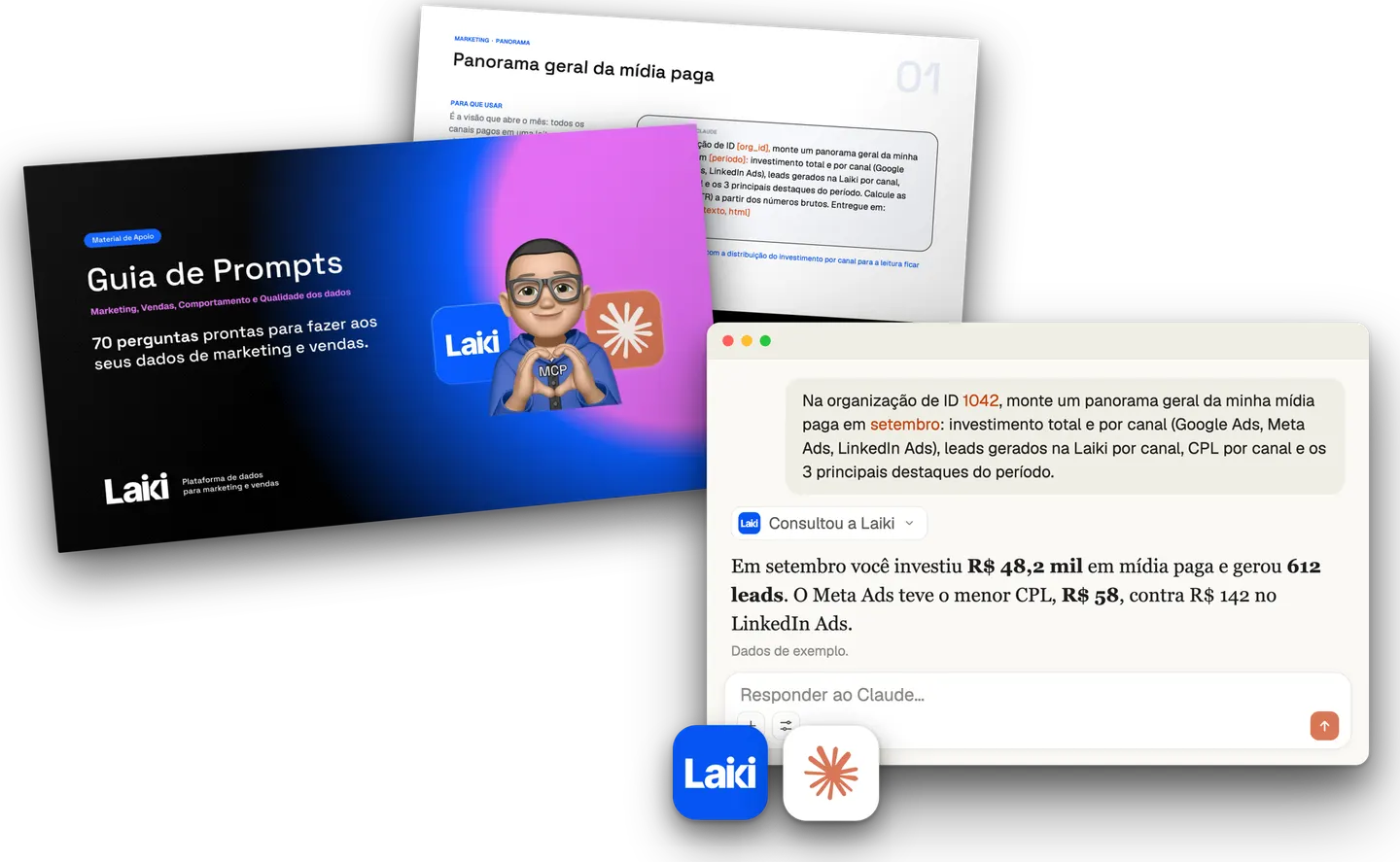 Resource · In PortuguesePrompt Guide for Marketing and Sales70 prompts with questions about marketing, sales and behavior to ask your data.Download the guide
A real example
Willian Martins, Marketing Manager at Dimas Construções, lived this problem before unifying the operation's data: “Centralizing scattered data enabled real-time KPI analysis and faster, more reliable decisions.” The change did not come from hiring more people to merge spreadsheets, it came from the data being centralized in one place, ready to answer the question as soon as it appears.
How this works without a dedicated technical squad
Data centralization brings together paid media, leads, deals, and customers in a single infrastructure, with automatic organization and standardization, integrating sources such as Meta Ads, Google Ads, LinkedIn Ads, GA4, RD Station, HubSpot, Pipedrive, and other CRMs. When a source has no ready-made integration, Workflows (in Beta) let you build the connection in a no-code builder, with webhooks and HTTP requests to any public API, without anyone writing a line of integration code from scratch.
The central difference from the traditional ETL path is that identity modeling and field standardization already come ready on the platform. What is left for your team is configuring which source to connect and adjusting business rules, not designing a schema or keeping a pipeline running.
Practical step by step to get off spreadsheets
List all the sources that today feed some marketing or sales spreadsheet, even those that only one person uses. Identify, among them, which ones already have a ready-made integration on the chosen platform and which would depend on a connection via workflow. Start with the source that generates the most manual rework today, usually the one that crosses paid media with the CRM, because that is where lead duplication shows up the most. Only after that base is reliable, migrate the secondary sources, one at a time, checking that the volume of leads matches what the old spreadsheet recorded before switching it off for good.
Frequently asked questions about unifying marketing and sales data
Do I need a data engineer to unify my marketing and sales data?
No, when the platform already handles lead identification and field standardization as part of the product. A data engineer becomes necessary on the traditional ETL path, when each identification rule needs to be designed manually.
Can I keep some specific spreadsheets after migrating?
Yes, as long as they are not the source of truth for any metric shared between marketing and sales. A one-off spreadsheet for a small analysis is different from a spreadsheet that feeds the entire funnel.
How long does it take to get off spreadsheets for good?
It depends on the number of sources and how many already have a ready-made integration. Sources with a native connector usually become active within a few days; sources that require a custom workflow take longer, in proportion to the complexity of the source API.
Unified data is not a project, it is a permanent state
Getting off spreadsheets does not have to mean hiring a technical team or opening a months-long project. It has to mean choosing a platform that already handles lead identification and field standardization as part of its normal operation, leaving you only the configuration of sources and business rules. Discover the Laiki platform and the workflows for sources that do not yet have a ready-made integration, and see how your operation's data stays organized without becoming a separate project.