CAC payback: what it is and how to calculate it in practice
CAC payback: the formula, a calculation example and benchmarks by customer segment to know whether the return on your investment is healthy.
Published on
5 min read
CAC payback is the time a company takes to recover, with the revenue generated by a customer, the amount it invested to win them. While CAC shows how much it cost to bring in that customer, CAC payback shows when that investment pays for itself, and it is this second question that decides whether the acquisition cost is healthy or not.
We have already shown, in the article about CAC in complex B2B sales, how the long cycle and the many touchpoints distort the acquisition cost calculation. CAC payback comes after that calculation: knowing how much each customer cost, what remains is knowing how long it takes for that cost to come back.
What CAC payback is
CAC payback is the number of months needed for a customer's revenue to cover the cost of acquiring them. A CAC of R$ 4 thousand recovered in 8 months of subscription describes a very different operation from the same CAC recovered in 20 months, even with an identical acquisition cost in both cases.
That is why analyzing CAC alone is misleading. Two companies can have the same acquisition cost and completely different payback speeds, and it is this speed that determines how much cash the operation needs available to sustain growth.
How to calculate CAC payback
The CAC payback formula divides the acquisition cost by the average monthly revenue each customer generates.
- CAC : the total customer acquisition cost (media, commission, prospecting tools, when the calculation is the fully loaded CAC)
- Monthly revenue per customer : the average amount the operation receives per month from that customer, not counting upsell that is not yet confirmed
Consider a company that invested R$ 5 thousand to close a customer and receives R$ 1 thousand per month from them. CAC payback is R$ 5 thousand divided by R$ 1 thousand, that is, 5 months until the investment pays for itself.
Those working with tight margins usually refine the calculation by multiplying monthly revenue by gross margin before dividing. That way the payback reflects the money left after the cost of serving that customer, not gross revenue.
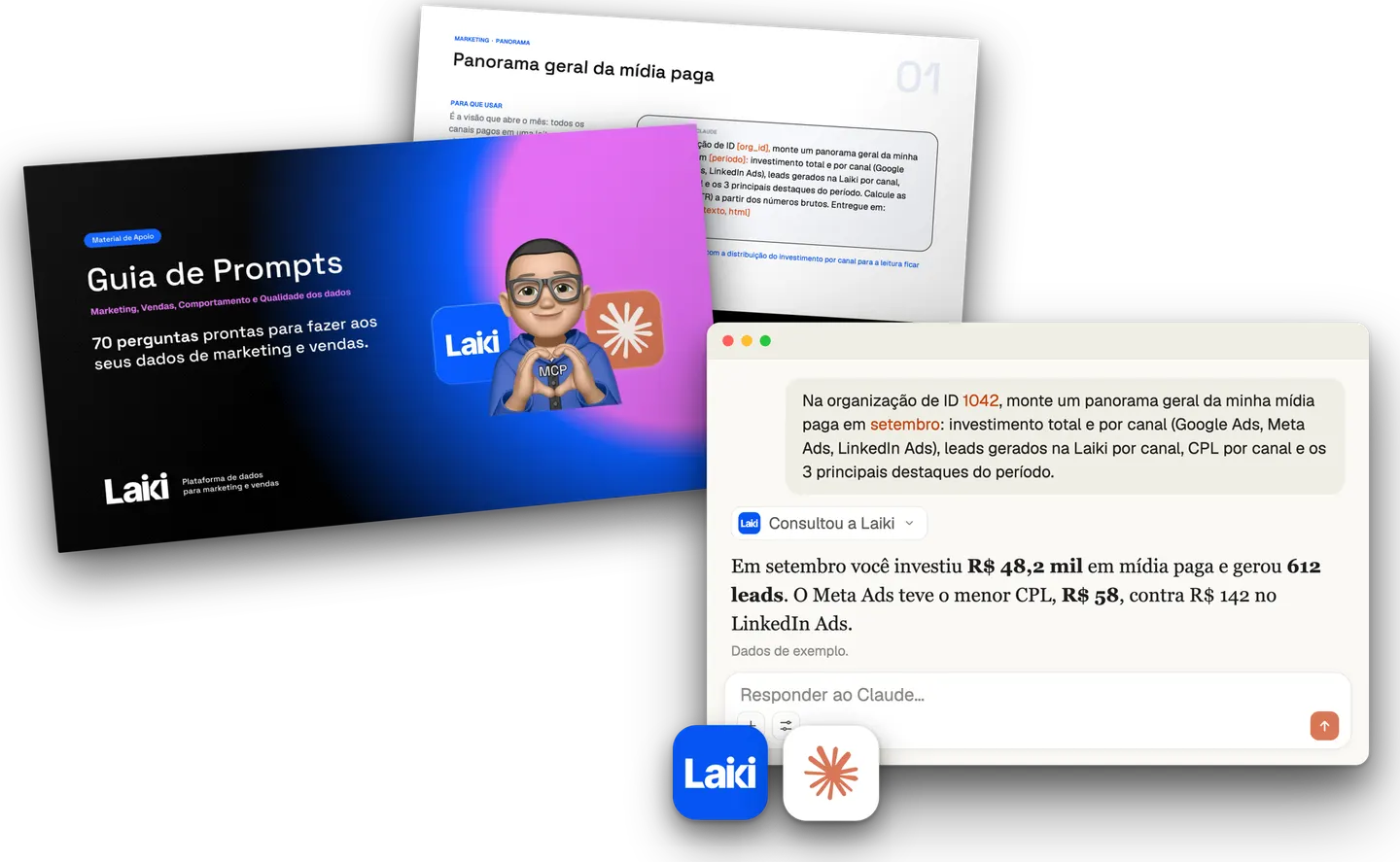 Resource · In PortuguesePrompt Guide for Marketing and Sales70 prompts with questions about marketing, sales and behavior to ask your data.Download the guide
Why CAC payback matters more than CAC alone
CAC payback answers the question that CAC alone does not: how long the company needs to hold cash until that investment comes back. A high CAC can be healthy when the payback is short, and a low CAC can be a problem when the payback drags on for two years.
This reading changes concrete decisions. A campaign with a higher CAC and a shorter payback may make more sense for the operation's cash than a cheap channel whose return takes a long time to show up.
What a good CAC payback is
There is no single CAC payback number considered good, because it varies by customer segment. A survey by First Page Sage covering more than 50 SaaS companies shows this difference by customer profile:
- End consumer (B2C): around 6 months
- Small and medium businesses: around 12 months
- Middle market: around 17 months
- Enterprise accounts: around 22 months
The practical reading is that a larger contract tolerates a longer payback, because the customer's value over the relationship also grows. Comparing your operation's payback with that of another customer segment rarely helps the decision.
How to reduce CAC payback
Reducing CAC payback has two paths: lowering the acquisition cost or increasing the revenue each customer generates early in the relationship.
- Prioritize the channels with lower CAC without a proportionally lower average ticket
- Review the funnel stage where the conversion rate is dropping, before cutting media budget
- Bring upsell and additional modules forward to the first months of the contract, when it makes sense for the customer
- Shorten the sales cycle, reducing the time between first contact and signature
A simple caution: cutting acquisition budget also reduces CAC on paper, but it does not change the payback if revenue per customer stays the same. The real gain is in working both ends of the calculation.
How to track CAC payback in practice
Tracking CAC payback requires looking at the same customer from two angles, the cost of acquiring them and the revenue they generate month by month, without losing their identity between systems. Without this join, a lead becomes two or three different records between marketing and finance, and the payback calculation becomes impossible to close.
In Laiki, calculated metrics let you build this indicator with the operation's own formula, crossing the CAC determined in the funnel with the revenue coming back from the CRM or finance. To go deeper into CAC, LTV and the other indicators in this calculation, the Marketing and Sales Metrics Guide brings together the formulas with a practical example.
It is worth complementing with the article about LTV, average ticket and revenue by channel, because CAC payback and LTV answer different questions about the same customer: one measures the speed of the return, the other measures its total size.
Frequently asked questions
What is the difference between CAC and CAC payback?
CAC shows how much it cost to acquire a customer. CAC payback shows in how many months that cost comes back, dividing CAC by the monthly revenue the customer generates.
Is a high CAC payback always bad?
Not by itself. A longer payback can be healthy when the customer has a larger contract and stays longer, as long as the company has the cash to sustain the wait.
Does CAC payback change in complex B2B sales?
It does, for the same reason that distorts CAC itself: the cycle is long, and a month's investment only generates a customer months later. It is worth applying the same cohort logic used to correct CAC in this scenario.
How often should CAC payback be recalculated?
Monthly, tracking the trend, and always reviewed when the average ticket or the acquisition cost changes significantly.