5 data hygiene routines to run every month
Data hygiene in marketing: 5 monthly routines, with the step by step, the signal that reveals each problem and what it breaks in the report.
Published on
6 min read

Data hygiene is the routine of checking, month by month, whether what enters your base is still entering the right way. There are five checks, and each one has a signal that reveals the problem before it shows up as a wrong number in the results meeting.
The difference between this and an annual cleanup lies in the cadence. A marketing and sales base gets dirty continuously, because a new campaign comes in every week and a new form comes in every month. Run regularly, the routine below fits in one morning and costs far less than the meeting where someone has to explain why two reports from the same week show different numbers.
Each item brings what to do, the signal that reveals the problem and what it breaks in the report.
1. Check the UTM parameters of active campaigns
How to do it: list the campaigns that went live last month and open the destination link of each one. Check that the three basic parameters are there: source, medium and campaign name. Start with the highest-investment campaigns, which are the ones that distort the report the most when they fail.
The signal: direct traffic grew for no apparent reason. When a campaign goes live without parameters, the visitor arrives as (direct) and fattens precisely the line nobody can explain. A jump in direct traffic is almost never brand loyalty.
What it breaks: the channel that brought the lead disappears from the report, and next month's budget is decided without it. Worse: the error is not recoverable. A lead that came in without parameters came in without a source, and no later fix brings that information back. If you need to review the standard, we have a guide on how to set up UTMs.
2. Review lead duplicates
How to do it: export the leads created last month and sort by name, then by phone. Look for the same person appearing more than once. The two most common patterns in Brazil are the personal email coexisting with the corporate one and the phone registered with and without the ninth digit.
The signal: a salesperson mentions they called someone who was already a customer, or two different salespeople talk to the same contact in the same week. The sales team usually notices duplication before the report does.
What it breaks: the top of the funnel inflates and the acquisition cost appears lower than it is, because the same investment was divided by a number of people that does not exist. The conversion rate also drops artificially, since the denominator grew without a single extra sale being possible.
3. Check campaign naming
How to do it: read the names of the campaigns created in the month through the eyes of someone who will build the report six months from now. The test is simple: could you group these campaigns by type, by product and by period using only the name?
The signal: the channel report shows three similar lines that should be one, such as “black friday”, “BlackFriday_2026” and “bf-2026”. Another signal is someone on the team asking what the acronym of an old campaign means.
What it breaks: nothing groups. You lose the comparison between periods and each analysis becomes manual work of joining rows in the spreadsheet. It is the kind of problem that does not stop any report from coming out, but makes all of them more expensive.
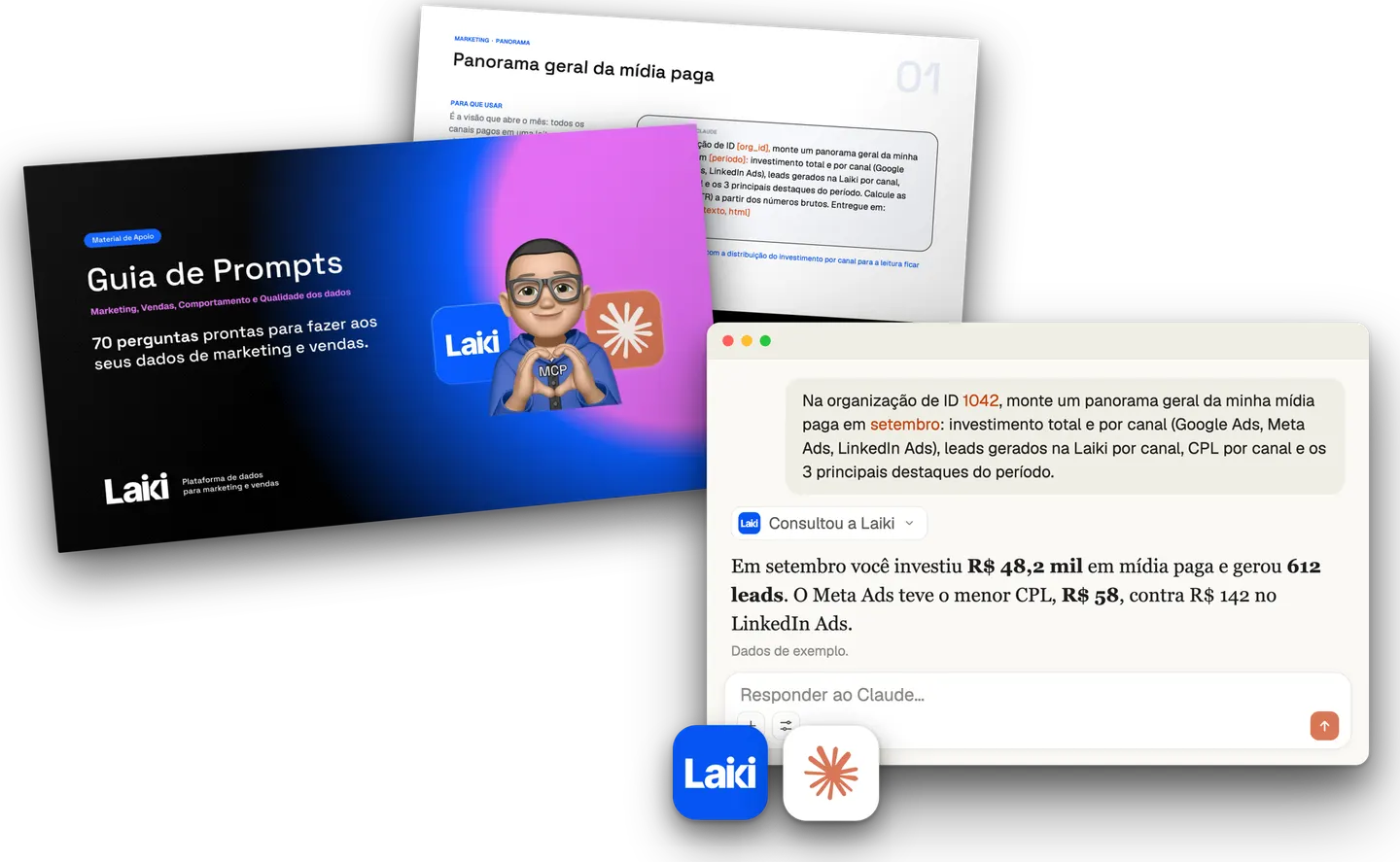 Resource · In PortuguesePrompt Guide for Marketing and Sales70 prompts with questions about marketing, sales and behavior to ask your data.Download the guide
4. Validate that integrations are still bringing in data
How to do it: put together a list of the sources that feed your base, source by source, and check the date of the last record received from each one. Website form, chatbot, CRM and ad account are part of the check. What you are looking for is a source whose last record is older than it should be.
The signal: a source that always brought in a similar volume dropped to zero or fell abruptly. The most common causes are an expired credential and a form changed by the website team without notice, with a renamed field that broke the submission.
What it breaks: this is the most expensive failure on the list, because it is silent. Nobody receives a warning when a webhook stops firing. The hole only shows up at month-end close, and by then the lost data does not come back. That is why this check deserves to be the most frequent of the five, ideally weekly.
5. Check the required CRM fields
How to do it: choose the fields that support analysis, not all the fields. In most operations there are four: deal value, lead source, loss reason and current stage. Measure the fill rate of each one across the deals created in the month.
The signal: reports with many blank records or marked “not informed”, and discussions about loss reasons that end in opinion because nobody has the number.
What it breaks: every metric that depends on these fields is left without a basis. Without the deal value filled in, there is no average ticket by channel. Without a categorized loss reason, nobody knows whether the operation loses on price or on timing. It is worth remembering that too many required fields also have a cost: the salesperson fills in anything to move the card forward, and then you have bad data instead of missing data, which is worse.
How to turn data hygiene into a routine
Good data hygiene depends less on effort and more on cadence. Three decisions make the routine survive the second month.
A fixed date and a named owner. “Every month” without an owner never happens. Put it on the calendar, preferably in the first business days, when the previous month has already closed.
A record of what was found. Keep the fixes in a simple document. The history shows where the operation always goes wrong, and it is what justifies fixing the cause instead of repeating the repair.
Different cadences per item. The integrations check deserves to be weekly, because the damage is unrecoverable. The other four work well at a monthly pace. Contact base specialists defend exactly this logic: a continuous program with defined cadences, instead of one-off task forces.
Frequently asked questions
How often should I run data hygiene? Monthly for most checks, weekly for integration validation. The rule is how fast the problem becomes unrecoverable: data that did not come in does not come back, so this check needs to be more frequent than the others.
How long does this routine take? One morning, in mid-sized operations, once the standard is defined. The first round usually takes longer, because it finds the accumulation of months and not just that of the month.
Who should be responsible? Whoever builds the monthly report, because they feel the consequence first. Delegating to someone who never had to explain a strange number in the meeting usually turns into a task completed without attention.
Can it be automated? In part. UTM standardization, merging records of the same customer and protection against duplicate submissions can be solved at data entry. Campaign naming and CRM field completion depend on agreement between people, and no tool solves that alone.
Less checking, more standard at entry
The best hygiene routine is the one that shrinks over time. A good part of these checks stops existing when collection is standardized at entry. At Laiki, UTMs are organized automatically, the records of the same customer merge into a single profile and workflows have protection against duplicates when the same form fires twice. What is left for the routine is what truly depends on human decision.
To settle your operation's standard before running the first check, download the Data Management Playbook, with campaign naming, the UTM manual and the custom fields guide in a single document.