How to choose a marketing and sales data platform: 9 criteria and a decision matrix
Nine criteria that separate data platforms that work from those that depend on a project that may never start, each with the right question for the demo.
Published on
7 min read

Choosing a data platform comes down to what it demands from your operation in order to work, far more than to the feature list on the website. Two tools can offer dashboards, segments and integrations, and still one of them may depend on an analytical database you do not have and a data team you are not going to hire.
The nine criteria below separate those situations. Each one ends with the question worth taking to the demo, because that is where the difference shows up.
How to use the matrix
Give each criterion a weight from 1 to 3, according to the reality of your operation, and give each vendor a score from 1 to 5. Multiply and add up. The value of the exercise lies less in the total and more in the conversation it forces: when the team discusses the weight of each criterion, the real priorities come out.
1. Where the data is hosted and how it gets out
Some platforms keep the data on their own infrastructure, others read the database you maintain. Both architectures work, and the consequences differ in governance and in the risk of vendor lock-in. The point that tends to go unnoticed is the exit: the contract and the product must guarantee a complete export in a standard format, at no prohibitive cost.
Ask in the demo: if I end the contract tomorrow, how do I take my history with me, in what format and how long does it take?
2. Who operates it day to day
A platform operated by a data analyst and one operated by a marketing professional have different interfaces and limits. If your team does not write SQL, segmentation needs to work through visual rules, with a preview of the count before saving.
Ask in the demo: ask them to build, live, a segment with three combined conditions, and watch who on your team could repeat it alone.
3. Ingesting a source that has no native connector
Every connector catalog covers the popular sources. The missing source tends to be the most important one in your operation: the CRM specific to your industry, the WhatsApp bot, the ERP. It is worth understanding the alternative path, usually a webhook, an API or an HTTP request inside a flow, and who is able to set it up.
Ask in the demo: my source X is not in the catalog. What is the path, how long does it take and who needs to take part?
4. Lead identity resolution
The same person comes in through the form with one email, replies on WhatsApp with a phone number and shows up in the CRM with another record. Without a reliable merge rule, one lead becomes two, the funnel gets distorted and the acquisition cost appears lower than it really is. In Brazil there is an extra layer: phone numbers with and without the ninth digit, with and without the country code.
Ask in the demo: how does the platform handle two records of the same person with phone numbers in different formats, and what happens to the history after the merge?
5. Segments and automation in the same product
Seeing a group of leads is useful. Acting on it is what changes the result. When segments and automation live in separate products, every action becomes an integration, and every integration becomes a project. In the same product, the segment can trigger a flow as soon as someone enters it.
Ask in the demo: show me a segment becoming an automation trigger, from start to finish, without leaving the tool.
6. Activation in media and CRM
After building the audience, you need to put it to work: custom audiences on ad platforms, a field update in the CRM, an alert to the salesperson. Some platforms come with ready-made destinations, others solve it with a configured HTTP request. Both deliver the result, with different effort.
Ask in the demo: which destinations are native and what requires manual configuration?
7. Access by an artificial intelligence agent
This criterion did not exist in buying guides until quite recently and today it decides a lot. Almost every vendor advertises AI integration, and what sets them apart is what sits behind it: an agent that has to discover the database schema and write queries gets it right less often than an agent that talks to entities that are already modeled, such as lead, event, segment and campaign.
Ask in the demo: ask a business question in natural language, with my data, and show me where each number in the answer came from.
8. Operating cost beyond the license
The monthly fee is the visible number. The real cost includes implementation, maintenance of the integrations when APIs change, and the hours your team ends up spending on it. More flexible platforms tend to have a lower license and a higher operating cost, because part of the work stays with you.
Ask in the demo: what does my team need to maintain after implementation is finished, and how often?
9. Time to the first useful answer
How much time passes between signing the contract and having the first business question answered with confidence. That interval ranges from days to several months depending on the category chosen, because each one assumes different prerequisites.
Ask in the demo: with my current sources, when do I get the first reliable number on screen?
The matrix, ready to copy
| Criterion | Suggested weight | Vendor A | Vendor B |
|---|---|---|---|
| Data hosting and export | 3 | ||
| Who operates it day to day | 3 | ||
| Source without a native connector | 2 | ||
| Identity resolution | 3 | ||
| Segments and automation together | 2 | ||
| Activation in media and CRM | 2 | ||
| AI agent access | 2 | ||
| Operating cost | 3 | ||
| Time to the first answer | 2 |
The weights above are a starting point. An operation with a mature data team naturally lowers the weight of criterion 2 and raises that of criterion 1.
Where Laiki wins and where it is not the answer
Laiki was built for criteria 2, 4, 5, 7 and 9. The data model is born with lead, event, company and funnel stage; the ID Combiner resolves identity in three layers, with handling of Brazilian phone numbers; segments and workflows live in the same product; and the MCP server exposes business entities for the AI agent to query, instead of raw tables.
On criteria 1 and 6 the conversation changes. If the requirement is that the data stay in your own cloud, or if you need dozens of activation destinations with governance, the right answer lies in another category, and it is worth saying so before signing instead of finding out afterward. The comparison between the categories is in the article on the five types of marketing data platform.
You can test the criteria with your own data. Laiki works with a no-lock-in subscription and a guarantee window, and the current terms are on the pricing page.
Frequently asked questions
How do you compare vendors from different categories?
First separate them by category and only then compare within each one. Comparing a media pipeline with an operational platform produces a spreadsheet in which everyone looks incomplete.
What should you ask about data export?
Format, scope (raw data or just reports), timeline and cost. The answers to those four questions reveal the degree of dependence you are taking on.
Is it worth hiring a platform that requires a data team?
It is when that team exists and has spare capacity. When it does not exist, the platform becomes a project postponed indefinitely.
How much does the number of native connectors weigh?
Less than it seems. What matters is whether your specific sources are covered and what the path is for those that are not.
The criterion that sums up all the others
If you need to reduce the nine criteria to one, use this: what does this platform assume already exists in my operation. The answer separates, in one sentence, the tools that will work in two weeks from those that depend on a project that may never start.
When you want to see the nine criteria applied to your data, get to know Laiki in a demo.
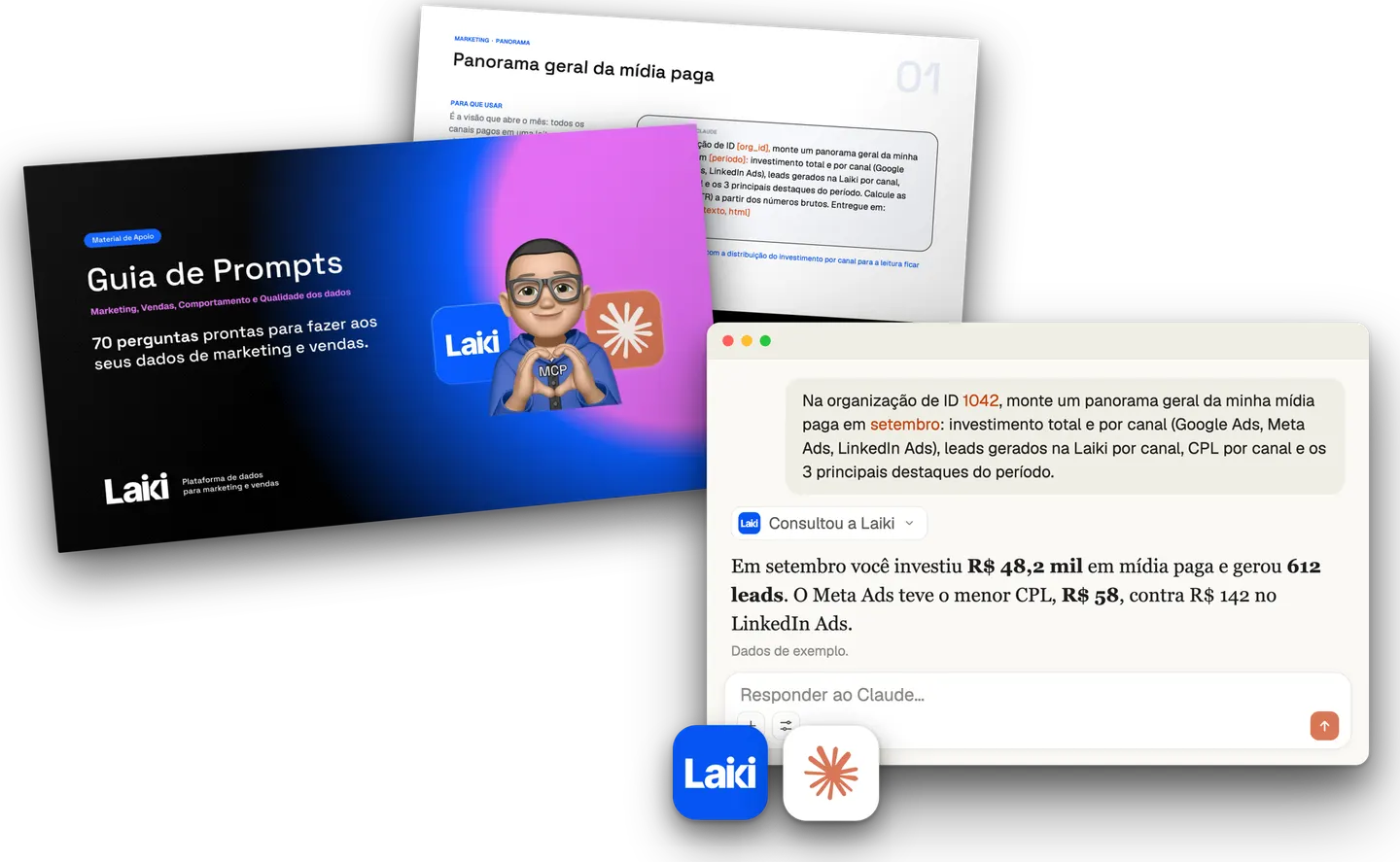 Resource · In PortuguesePrompt Guide for Marketing and Sales70 prompts with questions about marketing, sales and behavior to ask your data.Download the guide