Marketing data platforms: the 5 types and what each one demands from your operation
Marketing data tools fall into five categories that occupy different layers of the operation. See what each one delivers, what it demands from you and which one your operation fits.
Published on
8 min read

Anyone looking for a platform to organize marketing and sales data usually starts by putting vendors side by side in a spreadsheet. The comparison stalls right at the beginning, because half the list answers completely different questions from the other half. The tools in this market fall into five categories that occupy different layers of the operation: each one delivers one thing and charges its own price in return. The choice is settled by another question: which category your operation fits into today.
Below are the five, with what each one does, what it expects to already exist on your side and the scenario in which it is the right answer.
1. Media data pipeline
This category collects and standardizes ad data. It reads Google Ads, Meta Ads, LinkedIn Ads, Analytics and a few dozen more sources, harmonizes campaign naming, converts currency, resolves the difference in what each platform calls a conversion and delivers everything ready for a BI tool or an analytical database.
What it requires from you is the layer above. The pipeline has no notion of a person: it knows campaign, ad set, cost and click, and stops there. Whoever builds the chart, the CPL calculation and the reading of the funnel is you, in the visualization tool you already use.
It makes sense when the pain is clearly in media. If your operation has thirty ad accounts spread across several channels and nobody can add up investment without exporting a spreadsheet, this category solves the problem faster than any other. Well-known examples: Funnel.io, Supermetrics, Improvado, Adverity, Windsor.ai and, in the Brazilian market, Kondado.
2. Traditional CDP
The customer data platform, or CDP, builds the consumer's unified profile from several sources, segments that base and triggers personalized campaigns by email, SMS, push and other channels. It is the most complete category in activation, because the communication channel is usually part of the product itself.
The trade-off shows up in three places. The data model is the vendor's, so your operation adapts to it. Implementation involves several areas and takes much longer than a regular software purchase. And the entry price is high, because the category was born for large end-consumer bases.
It makes sense in retail, e-commerce and any business with many end consumers and recurring multichannel campaigns. Examples: Salesforce Data Cloud, Oracle, Twilio Segment and, in Brazil, Dito. If that is your reality, it is worth reading what a CDP is and when it makes sense.
3. Composable CDP and reverse ETL
Here the logic is inverted. Instead of the platform storing your data, it reads the analytical database you already maintain and pushes the audiences from there to the destination tools: media, CRM, email, support. This path back, from the database to the tools, is what the market calls reverse ETL.
What this category requires is the heaviest prerequisite on the list: a populated, modeled and maintained analytical database, with the concept of customer already resolved inside it. Without that, there is nothing to activate.
It makes sense when the company already has a data team and the bottleneck is in the last mile, that is, in getting the right audience to dozens of destinations with governance. Examples: Hightouch and Census.
4. Lakehouse and data platforms for AI agents
This category delivers infrastructure. It stores the raw data, organizes it into processing layers, allows free transformation in SQL or Python, controls permissions by table and exposes the result to anyone who wants to consume it, including artificial intelligence agents.
The requirement is having someone who models. The flexibility is total precisely because nothing comes decided: the schema, the business rule and the metric are written by someone on your side, and continue to be maintained by someone on your side.
It makes sense when marketing data is one use case among several, alongside finance, product and operations, and the company needs a single foundation. Examples: Databricks, Snowflake and, in Brazil, Nekt.
5. Vertical marketing and sales platform
The fifth category arrives with the data model already built for marketing and sales. Lead, company, event, CRM field, campaign and funnel stage already exist as concepts in the product, and on top of them come segmentation, dashboards, automation and AI agent querying. It is Laiki's category.
The trade-off is accepting an opinionated model. Since the entities come already defined, you gain speed and lose modeling freedom: the catalog of native connectors is narrower than that of a media pipeline, and sources outside it come in through webhook, API or HTTP request inside a workflow.
It makes sense when marketing and sales need to look, segment and act without depending on a data team. It is the most common scenario in operations that already invest in media and use at least one CRM.
Comparison of the five categories
| Category | What it delivers | Who operates it | What must exist beforehand | Time to the first useful answer |
|---|---|---|---|---|
| Media pipeline | Ad data collected and standardized | Media or BI analyst | A visualization tool (Power BI, Looker Studio, Tableau) | Days, after building the dashboard |
| Traditional CDP | Consumer profile, segmentation and sending | CRM team | End-consumer base and an implementation project | Several months |
| Composable CDP | Audience activation across many destinations | Data team with marketing | Modeled and maintained analytical database | Several months, counting the foundation |
| Lakehouse | Infrastructure and free transformation | Data engineering and analysis | Someone to model and maintain it | Several months |
| Vertical platform (Laiki) | Leads, events, segments, dashboards and workflows ready to use | Marketing and sales | Credentials for the sources you already use | Days |
Find your category in four questions
Check one answer for each question. The result appears at the end of the block.
Answer the four questions to see the category that fits your operation.
Frequently asked questions
What is the difference between a CDP and a CRM?
The CRM records the commercial relationship: negotiation, stage, the salesperson's history. The CDP gathers data from several sources to build a single profile and activate campaigns from it. In practice, the CRM is usually one of the sources that feed the CDP.
Does a data platform replace the BI tool?
It depends on the category. Media pipelines and lakehouses deliver data to the BI tool. The vertical platform already comes with the charts ready, so BI becomes optional.
What is reverse ETL?
It is the return path of data. ETL takes information from the tools to the analytical database, and reverse ETL returns segments and attributes from the database to the media, CRM and email tools.
Is a composable CDP the same as a CDP?
Both solve unification and activation, but in different architectures. The traditional CDP stores the data in the vendor's cloud. The composable one leaves the data in your database and only orchestrates the activation.
How to decide without getting the layer wrong
Comparing vendors from different categories produces a spreadsheet in which all of them look incomplete, because each was built to solve something else. Start with the layer: find out what your operation already has, who will operate it and which question needs an answer first. From there, the list of candidates shrinks on its own and the conversation with vendors becomes much more objective.
If before that you want to organize the base that will feed any of these categories, the Data Management Playbook brings the naming standardization, the source and medium values and the integration checklist ready to apply to your operation.
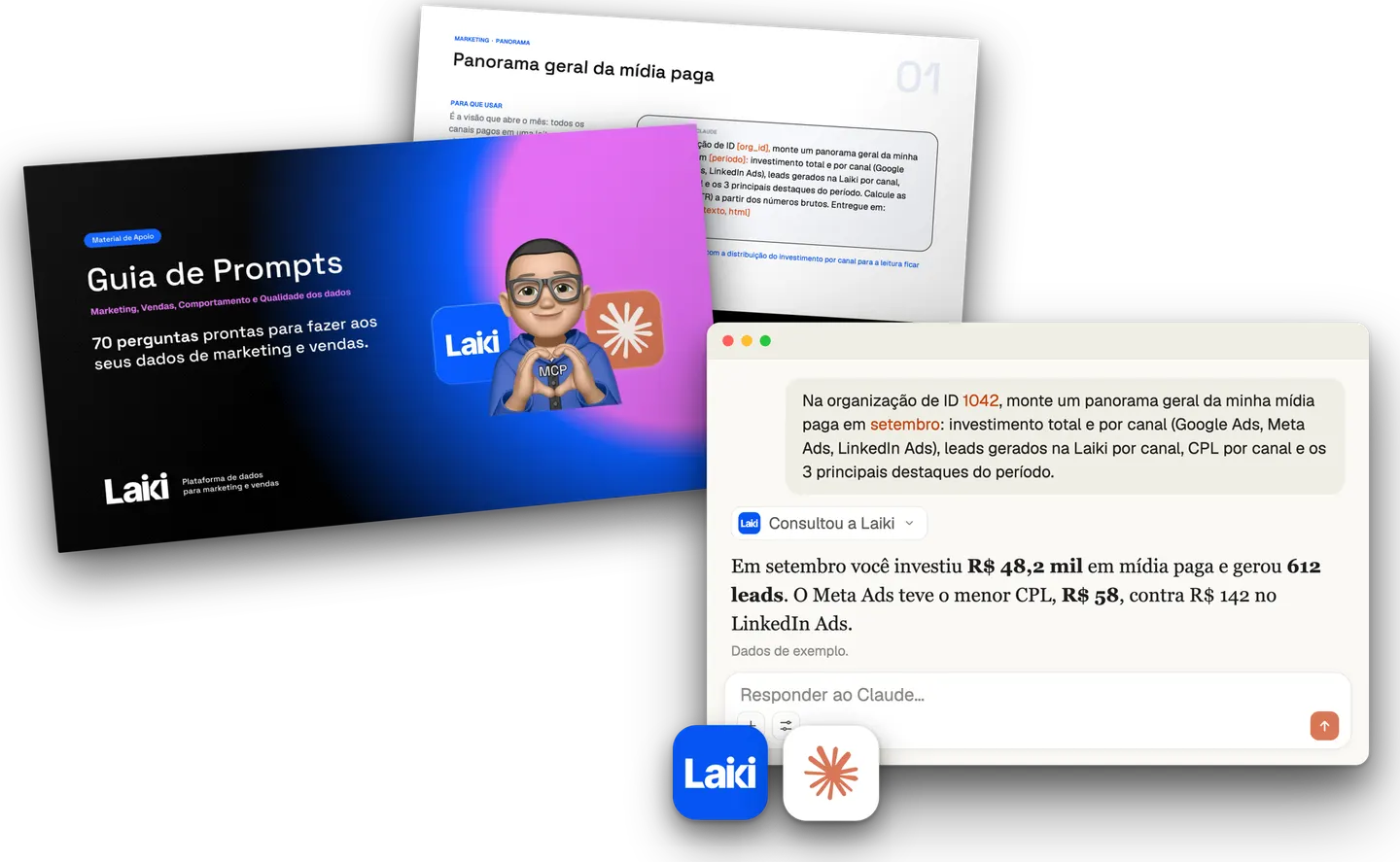 Resource · In PortuguesePrompt Guide for Marketing and Sales70 prompts with questions about marketing, sales and behavior to ask your data.Download the guide