What is a CDP: how it works, what it solves and when it makes sense for your operation
A CDP is the platform that gathers data from several sources, unifies the profile of the same person and activates campaigns from it. See how it works and in which operations it is not the right instrument.
Published on
6 min read

CDP stands for customer data platform: software that gathers data from several sources, joins everything that belongs to the same person into a single profile and makes that profile available for segmentation and campaigns. The most widely accepted definition in the market, from the CDP Institute, describes a marketer-managed system that creates a unified base accessible to other systems.
In practice, the category works in three layers: ingestion, unification and activation. Understanding these three is enough to know whether it answers the problem you have today.
How a CDP works, layer by layer
Ingestion. The platform receives data from the website, the app, the e-commerce store, the CRM, the email tool and, in many cases, the physical store. Each source arrives in its own format, and the CDP normalizes everything to a single standard.
Unification. This is the layer that gives the category its name. The same person shows up in the e-commerce store with an email, in the CRM with a phone number and in the store registration with a CPF (Brazilian individual taxpayer ID). The CDP crosses these identifiers and turns three records into a single profile. When this step fails, the effect shows directly in the numbers: one customer becomes two, the base swells and the acquisition cost appears lower than it really is.
Activation. With the profile ready, you segment by behavior and attribute, and send those segments to the communication channels. In many CDPs the channel already comes inside the product, with native email, SMS and push.
What sets a CDP apart from other tools
CRM. The CRM records the commercial relationship: who talked to the customer, which stage the negotiation is in, what was agreed. It sees its own data and nothing beyond it. The CDP is fed by several sources, and the CRM is usually one of them.
DMP. The data management platform works with anonymous audiences and third-party data, focused on advertising. The CDP works with first-party data, the kind your company collected with consent, and for that reason it better withstands the gradual end of third-party cookies.
BI. The business intelligence tool answers questions about the past in chart form. It does not join identities or trigger campaigns. The two coexist well: the CDP organizes and activates, BI analyzes.
The types of CDP that exist today
Traditional. The data stays in the vendor's cloud, in its model, with communication channels included. It is the most complete version and also the heaviest to deploy.
Composable. The data stays in your company's analytical database, and the platform takes care of building audiences and sending them to the destination tools. It gives more control and requires a database that is already modeled and maintained, plus people to do that.
Real-time personalization. It delivers the profile through an API at browsing speed, to change website content and offers during the session itself.
When a CDP is the wrong instrument
This is the part that rarely appears in the category's materials, and it is the one that most changes the purchase decision.
When your base is not made up of end consumers. The CDP was designed for operations with many consumers, a multichannel journey and recurring relationship campaigns. In a B2B operation, with a lower volume of leads and a purchase decision that goes through a salesperson, the value of mass personalization drops considerably, while the cost remains.
When the pain is in attribution and the sales funnel. If the question that stalls your Monday meeting is which channel generated the customers who signed contracts, the problem is one of connection between media, lead and CRM. The CDP solves this in an indirect and expensive way, when the direct path is a platform that already understands lead, event and funnel stage.
When there is nobody to sustain the project. A CDP deployment involves several departments at the same time. According to the cdp.com guide, mid-sized projects take 8 to 12 weeks, and enterprise deployments usually fall between 16 and 24 weeks, with phased releases that extend over several months. This timeline assumes someone dedicated to leading the effort. Without that person, the schedule slips and the tool becomes an idle license.
When the expectation is that it will fix the data. No CDP fixes messy campaign naming or missing UTMs. It joins and organizes what arrives. Bad input data stays bad after unification, now with the look of an official report.
What to look at before buying
Three questions separate a well-informed decision from a catalog purchase:
- Who operates it day to day? If the answer is a marketing person, segmentation needs to work without SQL.
- Where will the data live and how does it get out of there? A full export in a standard format is what protects you from being locked in to a vendor.
- What is the first business question that needs an answer? If it involves the sales funnel, also evaluate the category of vertical marketing and sales platform, which is born with lead, event and funnel stage as concepts of the product.
This last point is what explains the existence of tools like Laiki, which works on the same principle of unification, with a data model geared to marketing and sales instead of a consumer profile. The full comparison between the categories is in the article about the five types of marketing data platform.
Frequently asked questions
What is the difference between a CDP and a CRM?
The CRM stores the commercial relationship and sees only its own records. The CDP gathers data from several sources, resolves identity and delivers profiles ready for segmentation and campaigns.
What is the difference between a CDP and a DMP?
The DMP deals with anonymous audiences and third-party data for advertising. The CDP deals with identified first-party data, collected by the company itself.
Does a CDP replace a data warehouse?
The two coexist. The analytical database stores and processes data for analysis; the CDP organizes the customer profile and activates campaigns. In the composable version, the CDP relies precisely on the analytical database.
How long does it take to deploy a CDP?
It depends on the size and the quality of the input data. The cdp.com guide estimates 8 to 12 weeks for mid-sized deployments and 16 to 24 weeks in enterprise environments, with additional phases after that.
The work that comes before any platform
The CDP solves unification and activation for those with a consumer base and multichannel campaigns. For B2B operations and for teams whose central question is about funnel and attribution, there are more direct categories that are cheaper to operate. In every case, the result depends on the quality of what comes in.
If you want to start with that base, the Data Management Playbook brings together naming standardization, source and media values, custom fields and an integration checklist to apply before choosing any tool.
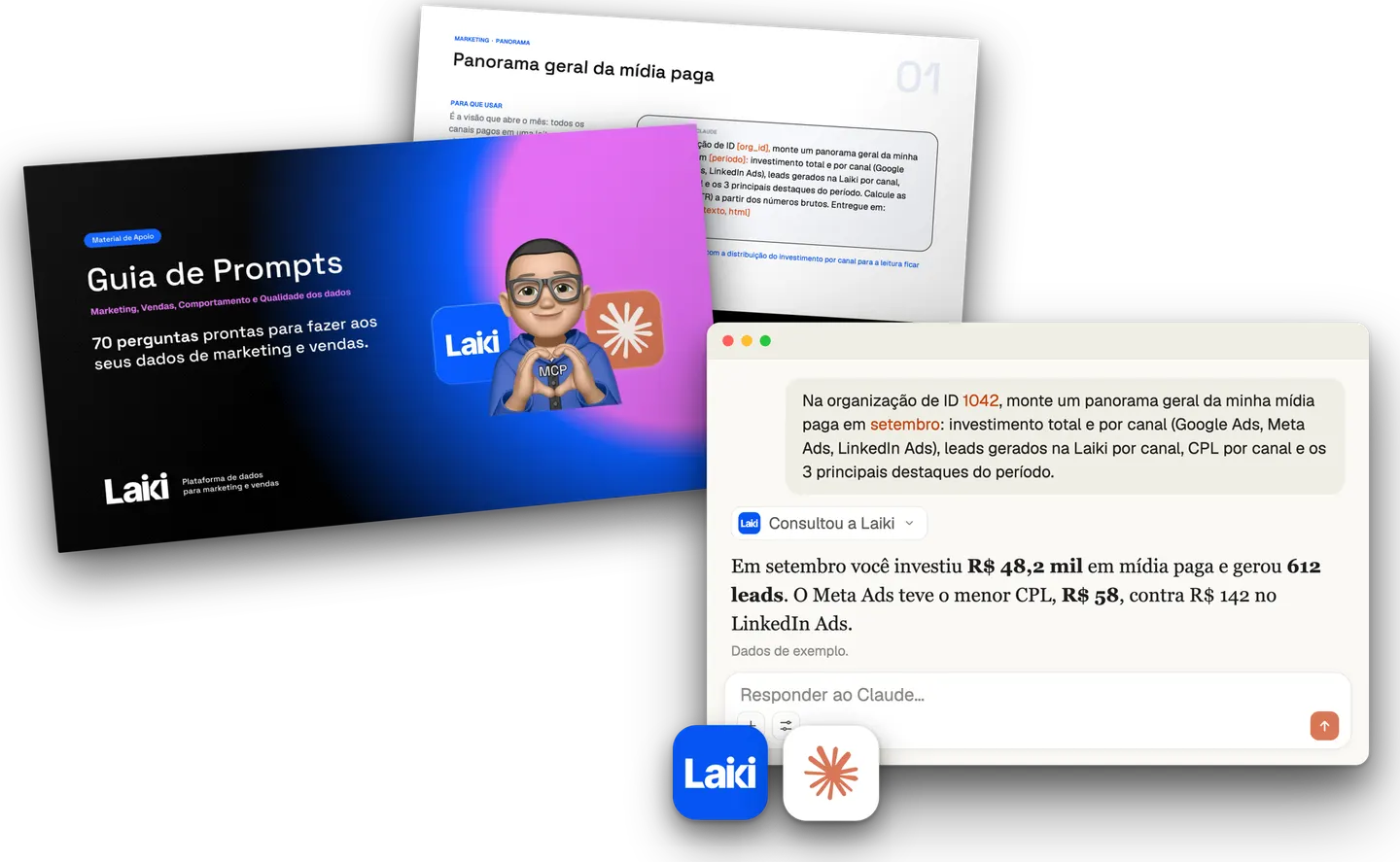 Resource · In PortuguesePrompt Guide for Marketing and Sales70 prompts with questions about marketing, sales and behavior to ask your data.Download the guide