Marketing and sales data management: how to organize before you automate
Discover the four layers of marketing and sales data management that works: collection, storage, governance and activation.
Published on
5 min read

Marketing and sales data management is the process of turning information scattered across tools, spreadsheets and different people's heads into a single reliable base, one that supports reporting, automation and decisions without depending on whoever remembers where the data went. Without that base, a beautiful dashboard is still poorly collected data with a chart on top.
Why just “having a CRM” does not solve it
Most operations already have a CRM, an automation tool and an ad platform. The problem is rarely a lack of tools. It is that each of these tools holds one part of the customer's story, and nobody has tied the parts together. A lead who clicked an ad, filled in a form and then talked to the salesperson on WhatsApp may become three different records, each in a different system, with nothing indicating it is the same person. The attribution report ends up wrong, the funnel ends up full of holes, and the decision on where to invest budget rests on a number that does not add up.
The four layers of data management that works
Skipping a layer to get straight to the dashboard is the most common mistake:
| Layer | What it guarantees | What breaks without it |
|---|---|---|
| Standardized collection | Every source records the same fields, the same way (UTM with fixed naming, not free text) | Lead source impossible to identify after a few weeks |
| Single storage | Marketing, sales and support converge on a common reference, even when operating in separate tools | Each team sees a partial and incompatible version of the same customer |
| Governance | A clear rule for what identifies a customer and what to do when two records seem to be the same person | Deduplication becomes a manual decision, made differently by each person |
| Activation | Indicators and automations get a reliable base to rest on | The CAC, funnel or attribution report carries the error that was already in the raw data |
A common example shows why the order of the layers matters. The operation wants to calculate CAC by channel, but the investment comes from the ads manager under one campaign name, and the customer acquired comes from the CRM under another name, with no field tying the two together. The calculation becomes impossible to do with confidence, not because a formula or a BI tool is missing, but because the data layer the formula assumes is already in place is missing. No dashboard fixes this afterward; the correction has to happen in collection and storage, before the indicator exists. This is the same kind of gap that appears when there is no clear distinction between metric and indicator: the number exists, but nobody has tied together the context that turns it into a decision.
Where most operations get stuck
In practice, most get stuck at the first layer. UTMs filled in differently in each campaign, a website form without the same fields as the WhatsApp form, a salesperson who notes things in the CRM in free text instead of a structured field. The effect shows up weeks later, when someone tries to build a report and discovers that half the records have no identified source, or that the same customer appears three times with the name spelled differently.
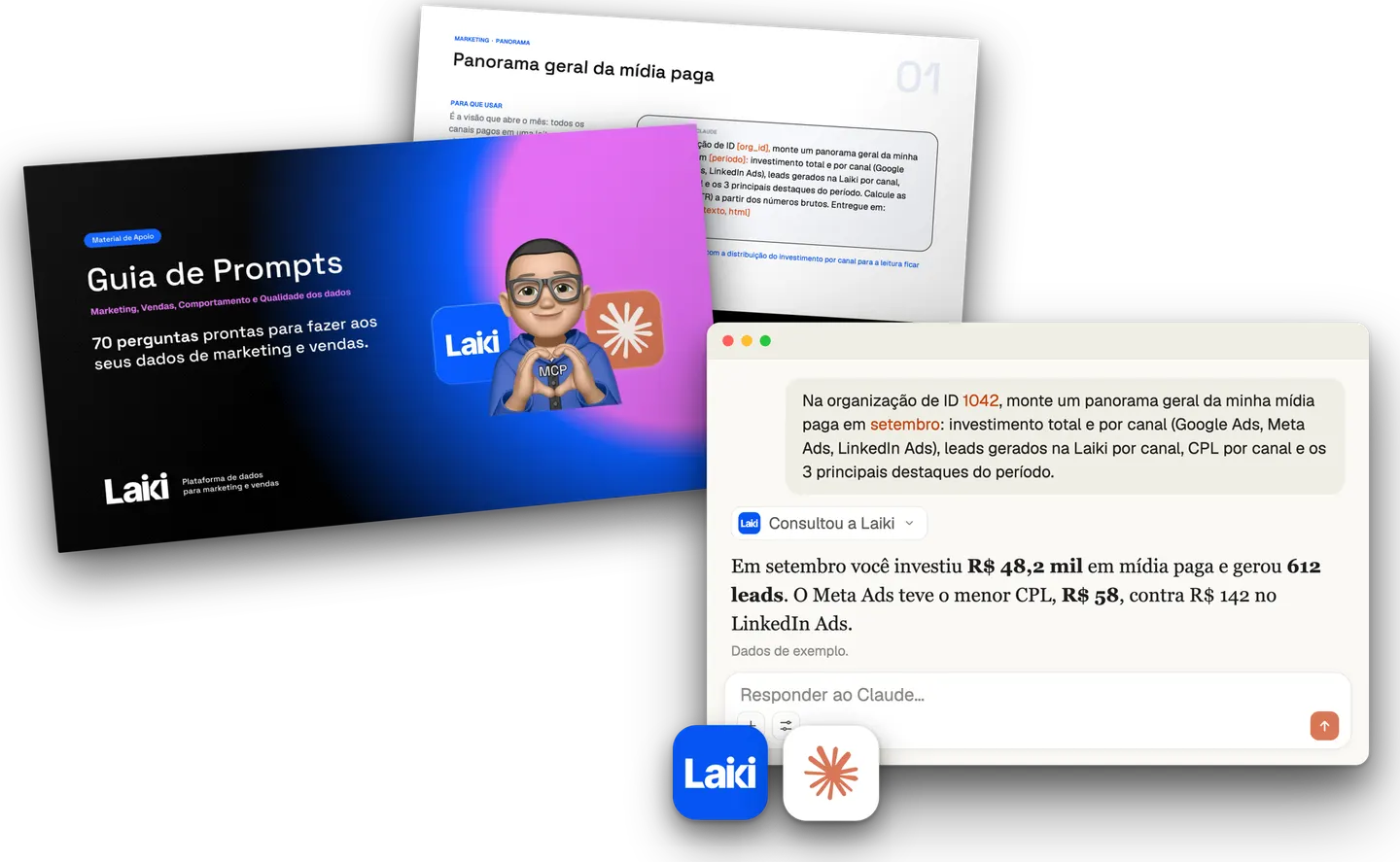 Resource · In PortuguesePrompt Guide for Marketing and Sales70 prompts with questions about marketing, sales and behavior to ask your data.Download the guide
How to apply this in practice
The path starts with an inventory, not with a new tool. List all the sources that generate lead or customer data today: website forms, ads, WhatsApp, manual spreadsheets, CRM. For each one, note which fields it collects and in what format. This inventory alone already reveals most of the inconsistencies, because it puts side by side what should be the same and is not.
After the inventory, define the customer's main identifier before connecting any new tool. If email is the key in one system and phone in another, the customer becomes two people as soon as the two systems need to talk to each other. It is the same problem, on a smaller scale, that appears when a channel changes the way it identifies the contact, as is happening now on WhatsApp.
Only then is it worth standardizing collection at the sources the inventory revealed as inconsistent, and testing governance with a real case before applying it to the whole base: take a customer who exists in more than one system and check whether the chosen identification rule really recognizes that it is the same person.
Frequently asked questions about marketing and sales data management
My operation already has a CRM. Isn't that enough to say data management is solved?
No. The CRM organizes what goes into it, but it usually does not solve collection from other sources nor guarantee that the same customer is recognized across different systems. It is one of the layers, not the complete solution.
Where do you start if the operation has never organized this?
With an inventory of the data sources, without changing any tool yet. It shows exactly where the inconsistency is before any technology decision.
Is this different from metrics and indicators?
Yes. Metrics and indicators are born after data management exists. Without standardized collection, single storage and governance, any indicator built on top carries the same error that was already in the raw data.
Organized data comes before the dashboard
Organizing these four layers before any new dashboard is what separates an operation that decides with real data from one that decides with a number that looks right. Laiki's Data Management Playbook details this process layer by layer, with the step-by-step of inventory, standardization and governance that this article summarized. Download the complete playbook and apply it to your operation before the next campaign.