Marketing delivers MQLs, sales expects customers: how to align the two teams
Marketing and sales alignment: why the two teams show different numbers and the minimum agreement that fixes it.
Published on
5 min read

Marketing and sales alignment is not solved by choosing the right MQL definition. It is solved when both teams look at the same number and share the same goal. The argument over acronyms is the surface of a deeper disagreement: each team is being held accountable for different things.
Marketing has a qualified-volume target and delivers the lead that meets the agreed criteria. Sales has a revenue target and considers a good lead one that closes a deal. Both are right by their own yardstick, which is why the meeting stalls with two numbers for the same thing. At the end of the month, this shows up as marketing and sales goals that never meet, when marketing hits its target and the company does not sell.
The symptom that shows up in the meeting
Someone from marketing presents a number of qualified leads for the month. Someone from sales replies that they received far fewer usable contacts than that. Nobody is lying.
The gap usually comes from three places. The qualification criteria were never written down, so each person applies their own. The discarded lead has no recorded reason, so marketing never finds out what was wrong. And the same contact entered the database twice, which inflates the number on one side without showing up on the other.
None of these three problems is solved with an alignment meeting. All three are record-keeping problems.
The mistake of treating the handoff as a border
There is a way of thinking that does more harm than missing criteria: the idea that marketing's work ends when the lead is delivered, and sales' work starts there.
When the handoff becomes a border, marketing optimizes for what it can measure, which is volume, and sales starts filtering on its own, without sending information back. Each team becomes efficient in its own piece and the company's result gets worse.
The approach that works is the opposite. Marketing follows the lead through to the sale, because that is the only way to know which campaign brings customers and not just volume. And sales sends the result back to the source, because that is what allows marketing to improve what it delivers. A filled-in loss reason field is worth more to the next campaign than any feedback meeting.
One point that many operations skip is worth highlighting: the moment when sales confirms it accepted the lead. Without that record, the rejected lead is silently discarded and marketing never finds out why. With it, the rejection becomes data and improves the process.
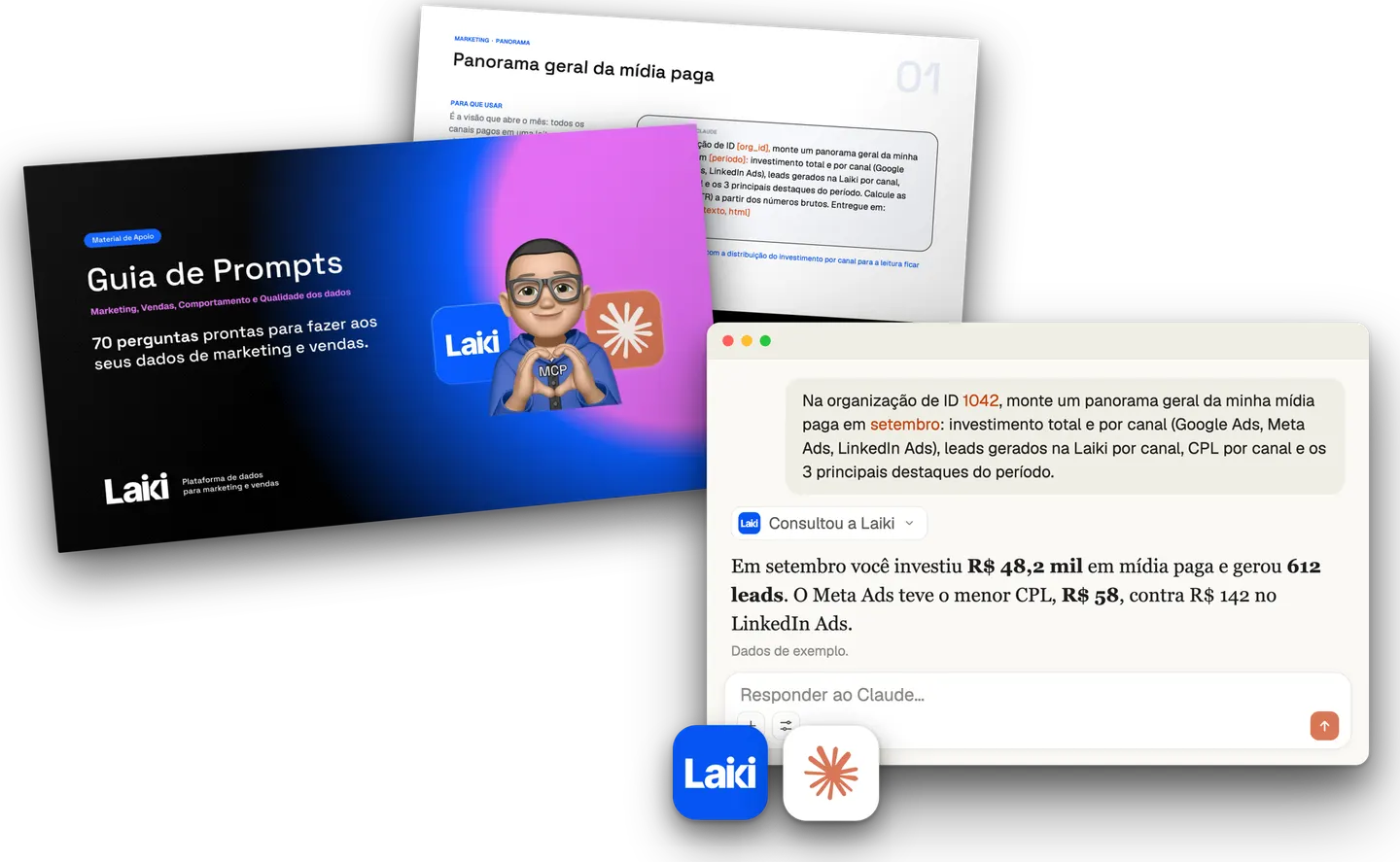 Resource · In PortuguesePrompt Guide for Marketing and Sales70 prompts with questions about marketing, sales and behavior to ask your data.Download the guide
The SLA that exists on paper and not in the database
A case published by Forrester itself shows the size of the problem well. In a SiriusDecisions engagement (now part of Forrester), the team asked the client whether marketing and sales had agreed on a definition of a qualified lead and established an SLA. Marketing said yes, proud that the leads it originated accounted for more than 95% of the pipeline.
The inspection told a different story. More than 65% of the leads reported as qualified and accepted had been stuck at the same initial stage for more than 90 days. The pre-sales reps were paid for quantity, not quality, which led to informal agreements to accept almost everything without inspection. And there was a rule in the integration between the marketing tool and the sales tool that automatically promoted an accepted lead to a qualified lead when the sales team did nothing within 14 days.
The agreement existed, the metric existed, and neither described reality. As Forrester's own text sums it up, the "A" in SLA stands for agreement, not for assignment.
It is worth looking at how the case was fixed, because the four measures are about records and incentives, not speeches: jointly defining what a qualified lead is, changing pre-sales compensation to reward quality, flipping the automatic-accept rule into an automatic-reject rule, and bringing SLA compliance into the weekly forecast meeting.
The minimum agreement for marketing and sales alignment
You do not need a long document. Three agreements cover most of the friction.
Written criteria. What makes a lead count as qualified, in objective terms: profile, behavior, and timing. Written in a place both teams can access, with the date of the last review.
Recorded reason. Every rejected or lost lead leaves with a reason in a structured field, not in free text. That field is what answers why a specific channel generates many leads and few sales.
Stage change date. Every move records when it happened. This is what makes it possible to measure response time and cycle length, and it is almost always what is missing when someone tries to calculate a revenue forecast later.
With these three, the conversation stops being about perception. When marketing and sales argue about lead quality, the agreement is to open the database and look at the rejection reason by source.
How to move the criteria out of the conversation and into a rule
Written criteria still depend on someone applying them the same way every day. The next step is to turn them into a rule that runs on its own.
That is what Laiki's Lead Scoring does: you configure profile and engagement as points, and each lead is classified automatically, in real time, as events happen. The yardstick becomes the same for everyone, and the discussion about qualification becomes a discussion about where to adjust the weight of each criterion.
This depends on both teams being on the same database, with the entire funnel visible. We wrote about this setup in the article on unified marketing and sales funnel, and about the name the market gave to this integration in what is RevOps.
Frequently asked questions
What is the difference between MQL and SQL?
An MQL is a lead that meets the criteria defined by marketing, usually profile plus engagement. An SQL is a lead that sales has confirmed as a real opportunity. The difference between the two varies by company, and that is precisely why it needs to be written down.
Do we need a formal SLA?
A formal document helps in a large operation. In a small team, the three agreements in this article already solve most of the friction, as long as they are written down and reviewed from time to time.
How can we tell whether marketing and sales alignment has improved?
Two simple measures: the rate of leads accepted by sales and the average time to first contact. If both improve, the agreement is working. If only volume grows, it is not.