Last-click versus first-click: how to choose your operation's attribution model
Last-click or first-click attribution model: which question each one answers, how to choose, and the mistake of comparing the two in the same meeting.
Published on
5 min read
First-click answers what generated the discovery and last-click answers what closed the sale. Both look at the same lead and arrive at opposite answers about which channel deserves the budget. That is why choosing between them is an operations decision, not a technical preference.
The quickest way to understand the difference is to follow a single lead down both paths.
The same lead, two results
Consider this journey, with values used only as an example. A person sees an ad on Instagram and visits the website for the first time. Two weeks later, they come back through organic to read an article. A month later, they search for your company name on Google, click the brand ad, fill out the form, and close a R$ 12 thousand contract.
In first-click, the R$ 12 thousand goes to Instagram. In last-click, the same R$ 12 thousand goes to Google Ads. Organic, which held the person along the way, appears in neither.
Now multiply by ten customers with a similar journey. That is R$ 120 thousand that moves entirely from one channel to another depending on the model chosen, without a single sale having changed. It is this shift that decides which campaign survives next month's budget review.
Which question each one answers
First-click answers where demand is born. It shows which channels bring new people into your base and is the most useful for evaluating discovery campaigns, top-of-funnel content, and reach media. The limit is clear: it gives credit to the first touch even when the sale took six months and went through ten interactions afterward.
Last-click answers what was in front when the person decided. It works well for direct conversion campaigns and short cycles. The limit is also clear: it frequently rewards the brand ad and remarketing, which often only harvest demand that another channel built.
Each attribution model is right within the question it answers. The problem appears when someone uses the answer from one to decide what only the other could answer.
How to choose your operation's attribution model
Three criteria solve most cases.
The length of the sales cycle. A short cycle, of days, has few touches and last-click is rarely wrong. A cycle of months, with several people deciding, makes last-click a fragile reading.
What you are evaluating right now. If the question is where to open a new acquisition front, first-click answers better. If the question is which campaign to cut this week, last-click answers better.
Who will read the report. Leadership usually wants to know where customers come from, which pulls toward first-click. The media team needs to optimize active campaigns, which pulls toward last-click. Running both, side by side, resolves most of this tension.
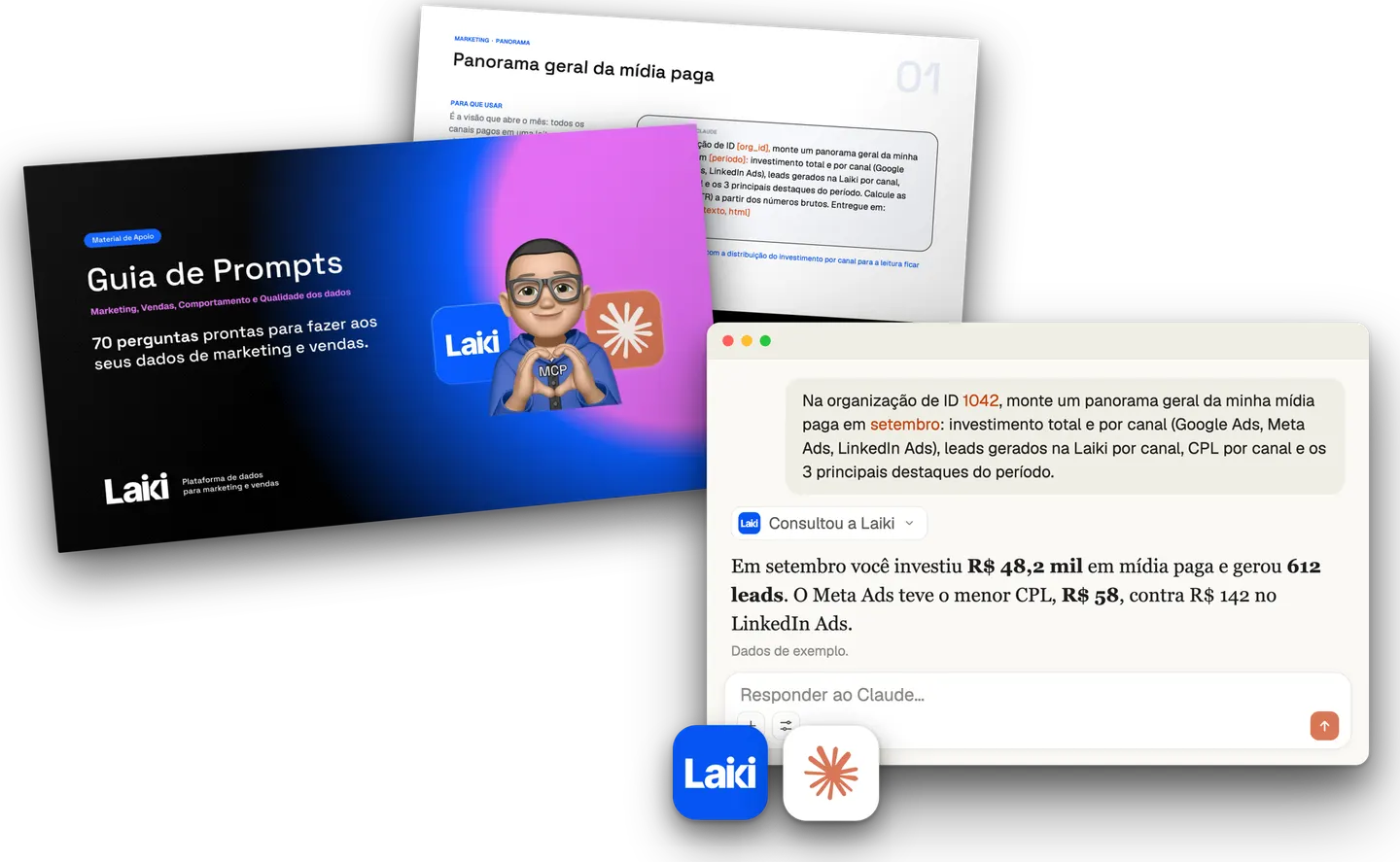 Resource · In PortuguesePrompt Guide for Marketing and Sales70 prompts with questions about marketing, sales and behavior to ask your data.Download the guide
The mistake that shows up in the meeting
There is a classic mistake and it is hard to notice in the middle of the conversation: comparing two reports built on different models as if they spoke the same language.
Someone opens the Google Ads dashboard, which works on last-click logic, and someone opens a lead source report built on the first touch. The two numbers do not match, the meeting spends forty minutes arguing about which is right, and in the end the decision goes to whoever spoke the loudest.
Both were right. They were answering different questions. The practical rule is simple: before comparing two channel numbers, confirm that they were calculated on the same model and the same time window.
What changed in GA4
A practical warning is in order, because a lot of content on the subject is outdated. The official Google Analytics documentation records that the first click, linear, time decay, and position-based models ceased to exist in GA4 in November 2023. What remained were data-driven and the last-click variations.
In practice, if you want to read your operation through the first click, GA4 alone no longer delivers that. The reading needs to come from somewhere else, with source data stored per lead.
Correlation is still not causation
One caution that runs through both models: attribution shows presence, not cause. The channel that appears in the first touch was there when the person arrived, which is different from having been the reason for the purchase. Whoever wants to claim cause needs to test, pausing a channel and observing the effect, instead of deducing it from the report.
Treating attribution as strong evidence, and not as proof, avoids the hasty decision to cut an entire channel because of one slice of data.
Frequently asked questions
Can you use both models at the same time? Yes, and it is the most recommended approach. One answers where to invest to generate new demand, the other answers what to optimize in the campaign that is running. The caution is to never add the two together, because each one already attributes 100% of the value.
Which attribution model does my CRM use? In most cases, the lead source field stores the first recorded touch, and the ad platform's dashboard works on last click. Confirm this before comparing the two, because this difference is the silent source of a good part of the number discrepancies.
What about the middle of the journey, does it get no credit? In both models, yes. Intermediate touches only show up in multi-touch models, which require a higher conversion volume to be reliable.
Reading your operation in both models
The choice stops being a dilemma when you can see both numbers side by side. In Laiki, UTMs are organized automatically at entry and attribution is recorded lead by lead, in both first-click and last-click. The same base answers both questions, and the meeting discussion becomes about the decision, not about which spreadsheet is right.
Discover Laiki's platform and see how the lead's complete path, from the first click to the sale, is recorded in one place. If you want to go deeper first, it is worth reading our guide on how to configure UTM, because no model works on missing parameters.